Wadden Islands


The Wadden Islands attract people throughout the year because of the unspoiled nature reserves, wildlife, beautiful beaches and charming villages. In spring and autumn they are the perfect place for a refreshing break, while in summer you are assured of a delightful beach holiday.
World Heritage List
In June 2009 UNESCO has put the Wadden Sea on the World Heritage list. The area has been placed on this list because it’s unique in its variety. The Wadden Sea has many different kinds of habitat and therefore offers a home to many plant and animal species. Furthermore the Wadden Sea is unique in the whole world in demonstrating how nature, plants and animals adapt themselves to constantly changing conditions in an area where fresh water (from land) and salt water (from the ocean) meet. Low and high tide alternate every six hours in the Wadden Sea, bringing about stunning changes to the landscape almost every minute of the day.
Texel
The island of Texel is the largest Wadden Island of the Dutch mainland. The ferry will take you from Den Helder to the island in less than 30 minutes. You may take your car, although the approximately 20-mile-long island does have its own public transport system and a good taxi-van service.
There are seven villages on the island; Den Burg is the island's capital. An extensive cycle path network links the villages and leads through the many nature reserves. Hop on a bike to the EcoMare Seal rehabilitation center, or to the extensive woods, and last but not least to the beachcomber museum, where a real beachcomber will show you his collection.
Vlieland
When you visit Vlieland, you become a real islander. The crossing from Harlingen takes two hours and you have to leave your car on the mainland. Since only the people who actually live on the island are allowed the use of a car, the island is very quiet. The extensive cycling and walking paths network will take you past vast scenic areas with woods, tidal marshes and dune ranges. There is only one village on the island. Enjoy the space, tranquillity, as well as conviviality and atmosphere on Vlieland.
Terschelling
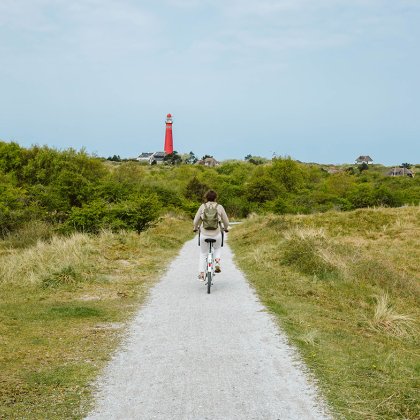
Even though, on a clear day, the Brandaris lighthouse on Terschelling will be visible almost as soon as you leave Harlingen on the mainland, the actual crossing takes almost two hours. This is because the ferry needs to skirt around the flats of the Wadden Sea. With a bit of luck you may also see seals basking in the sun on a flat. You will arrive in West Terschelling with its magnificent harbor, where many traditional sea cargo ships, now rebuilt as passenger ships, call port. Most visitors to the island leave their car on the mainland and traffic on the island is therefore restricted. There are plenty of cycling and walking paths that offer you a chance to enjoy the island and its scenic beauty. Polders, dune areas, tidal marshes and, most importantly, the long stretch of beaches will all contribute to a wonderful stay. Five small villages string a belt from west to east and all offer a host of accommodation facilities. The choice is yours!
Ameland
There are four villages on Ameland - Hollum, Ballum, Nes and Buren. The nature reserve Het Oerd provides shelter to rare flower species. The western part of Het Oerd consists of high dunes and dune lakes, the eastern part of tidal marshes and sand flats. Guided tours of the reserve are available. Ameland also has a rich bird and wildlife. Visitors will find a host of hotels, bed and breakfast inns and campsites. The lighthouse on the Oranjelaan in Hollum was built in 1880 and stands almost 20 feet tall. On Zuiderlaan Street you will find a late Gothic church with a beautiful saddle roof from the 15th century, which was superbly restored in 1678. Close to Nes lies the recreational park De Vleijen. The seagull colony in Het Oerd can be visited on excursions organized during the breeding season. Other activities include fishing trips on the (Wadden) sea and flights over the island.
Schiermonnikoog
This island, a 45-minute crossing away by ferry from Lauwersoog, has been classified as a National Park by the Dutch government and rightfully so! The island is one big nature reserve with woods and dune ranges. Cars are not permitted on the island. There is no need for alarm though. The island is very small and everything lies within easy distance along the walking and cycle paths. There is only one village on the island, also called Schiermonnikoog - a real picture postcard. Small-scale family hotels and other accommodation facilities will make you feel welcome and say "we'll be back".